

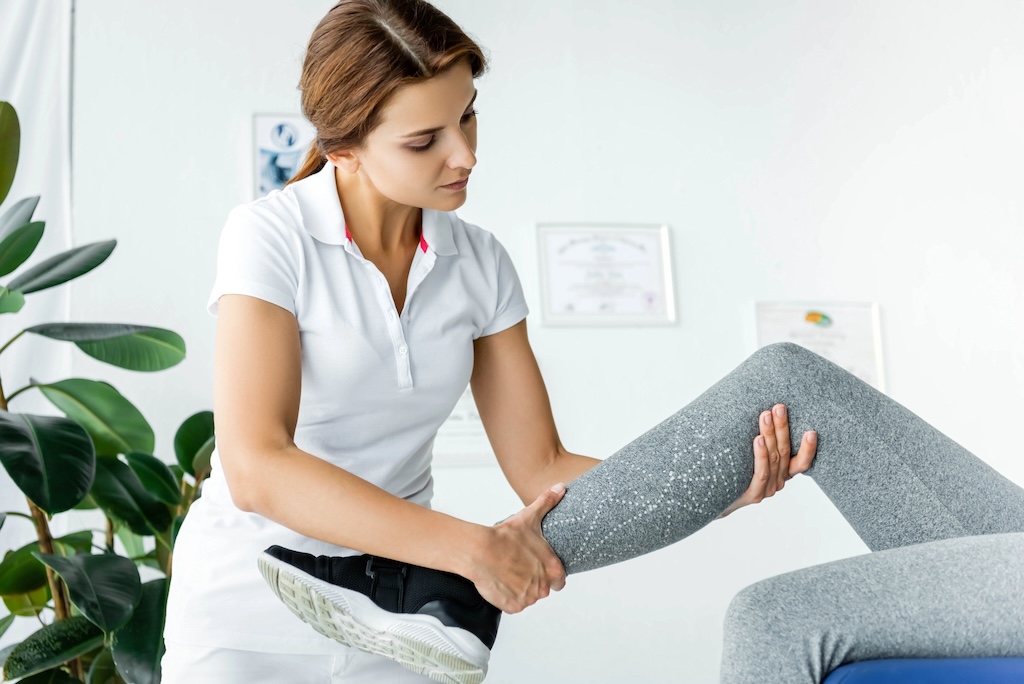
Here's something that doesn't get said enough: you squat all day long. Every time you sit down, stand up, climb into the car, scoop up a toddler, or grab something off a low shelf, you're squatting. So when your knees start complaining, it doesn't feel like a gym problem. It feels like a life problem.
And the questions come fast. “Am I doing something wrong?” “Are squats bad for my knees?” “How am I supposed to sit down and stand up all day if squatting hurts?” “Should I just stop?”
Knee pain when squatting is common, and it doesn't automatically mean something is wrong with your knees or that squatting is off the table. Here's the short version.
The short answer: Knee pain during squats can have several causes, including changes in training load, limited ankle or hip mobility, strength or coordination limitations, squat depth, and how your body is managing the demands of the movement. Knee pain does not automatically mean that squats are damaging your knees.
At Breakaway Physical Therapy, we rarely stop at the knee. Your knee is one link in a chain that runs from your feet through your ankles, hips, pelvis, and core, and how you move through that whole chain shapes what your knees have to deal with in a squat. So let's walk through why this happens, and what you can actually do about it.
How Squatting Affects Your Knees
Let's start with what a squat actually is, because it's more of a team sport than most people realize. As you lower down, your hips, knees, and ankles all bend. Your muscles control the way down, then produce the force to bring you back up. Quads, hamstrings, glutes, calves, and a handful of smaller supporting players all have a role.
Your knees are meant to bend in a squat, and they're built to handle a lot of force. What matters is how that force gets shared. When your hips and ankles carry their part, your knees can do their job comfortably. When they don't, your knees may end up absorbing more than their fair share.
That's where a simple idea comes in: capacity and demand. Capacity is what your body has been prepared to handle. Demand is what you're asking of it right now. When demand outruns capacity, pain often shows up in the gap. The good news is that capacity is something we can build.
9 Reasons Your Knees May Hurt During Squats
Knee pain when squatting rarely has a single culprit, and the mix looks different from one person to the next. Most contributors fall into five buckets: how much you're asking of your body (training load), how freely your joints move (mobility), how strong the supporting muscles are (strength), how well it all works together (coordination), and how well you're recovering in between (recovery). The nine below touch every one of them. Read them as possibilities worth exploring, not a diagnosis.
1. You're Doing More Than Your Body Is Ready For
If your knees started hurting soon after something changed, start here. Maybe you hadn't worked out in months and decided to do 50 squats a day. Maybe you bumped up the weight on your bar. Maybe you jumped back in after a long layoff and picked up right where you left off.
Muscles, tendons, joints, and connective tissue all respond to the loads you place on them, but on their own schedule, not yours. When the jump is too big or too fast, or when you're starting from a low baseline, your tissues can push back. That doesn't mean you've hurt your knee. It often just means the volume, intensity, or frequency needs to come down for now.
Think of it this way: if you haven't run in a year and decide to knock out five miles, your legs will be sore, and not because running is bad. Your body just hadn't been prepared for that much stress. Squats work the same way when you haven't been doing them regularly.
That's why a gradual ramp matters so much. You don't have to go from bodyweight squats to a heavy barbell overnight. Start where your body feels comfortable and turn up the challenge in small steps. A resistance loop above your knees or at your ankles, a 5 to 10 second hold at the bottom, or a 5 second pulse can make your legs work harder without adding a single pound.
2. Your Squat Technique May Need Some Attention
Let's get one thing straight: there is no single perfect squat. Your height, leg length, hip structure, ankle mobility, strength, and injury history all shape how a squat looks on you, so two healthy people can squat very differently and both be fine.
That said, some patterns can make the movement harder than it needs to be. See if any of these sound familiar:
- ✓ Your knees drift inward on the way down or back up
- ✓ Your heels lift off the floor
- ✓ One side seems to do more of the work, or your knees don't move the same way
- ✓ Your upper body folds far forward
- ✓ The way down feels shaky or out of control
- ✓ You have to fight to keep your balance
- ✓ Your knees travel well past your toes
None of these means you're squatting “wrong,” and none is a diagnosis on its own. Think of them as what you can see from the outside: clues, not conclusions. Knees that drift inward, for example, can be tied to how well your hips are controlling the movement, and heels that lift can point toward limited ankle mobility, but the same pattern can have different causes in different people. The next few sections get into what may be happening underneath, and a physical therapist can watch you squat and help sort out which of those apply to you.
3. Your Ankles May Be Limiting Your Squat
Nobody tells you that the answer to a cranky knee might start at your ankle. But think about it: to squat comfortably, your knees have to travel forward as you lower, and that takes ankle mobility, specifically dorsiflexion, which is just a technical way of saying your shin's ability to glide forward over your foot.
When the ankle doesn't give much, your body finds another route down. Heels pop up. Feet turn out. Weight shifts. Hips and knees change how they move to make up the difference. It's a clever workaround, but your knees may be the ones who pay for it.
That's why working only on the knee can leave you chasing the problem. Limited ankle mobility isn't the whole story for everyone, but it's one of the places worth looking.
4. Your Hips May Not Be Doing Their Share of the Work
Your glutes and the other muscles around your hips are the quiet workhorses of a squat. They steer your pelvis and thigh bone through the movement, and when they aren't pulling their share, your knees can end up covering for them. It's one reason hip strength and knee pain are so often discussed together in physical therapy.
Your knees should absolutely work hard. They're built for it! But a lower body works best as a team, and when one player is carrying less, someone else usually carries more. Whether hip strength, mobility, or coordination is part of your story is something an assessment can sort out.
5. Your Quadriceps May Need More Strength
Your quadriceps, the big muscles on the front of your thighs, do a lot of the heavy lifting in a squat. They control your knee on the way down and drive you back up. If they haven't been asked to do much lately, maybe after an injury or surgery, a long stretch of inactivity, or just a season of skipping leg day, squats can feel hard in a way that's easy to blame on the knee itself.
The way back is usually to meet your quads where they are. Start with something that matches your current strength, like sit-to-stands from a chair, partial squats, or other knee strengthening exercises, then build toward deeper or weighted squats as you get stronger.
6. Your Squat Depth May Be Too Much Right Now
Deep squats get a bad rap they don't deserve. For many people, a deep squat is a perfectly healthy movement. But being able to go deep and needing to go deep right now are two different things.
If you're hurting, trimming your depth for a while can keep you strengthening while irritated tissues settle down. Squat to a chair or bench instead of all the way to the floor, then earn your depth back as your strength, mobility, and tolerance improve.
The goal isn't to retire a movement forever. It's to find the right dose of it for your body right now.
7. Your Overall Training Load May Be Too High
Your knees don't experience squats in isolation, so zoom out. Are you squatting three days a week and running four? Playing in a rec league on the weekend? Did a new program quietly pile hundreds of lunges and jumps on top? Each piece might be perfectly reasonable alone. Stacked together, they can add up to more than your body can currently handle.
Sometimes the answer has nothing to do with the squat itself. What matters is what's happening around it: spacing out your hardest days, swapping some impact for lower-impact work, or building in more recovery. A physical therapist can look at your whole activity picture and help you build a plan that keeps you training while your symptoms settle down. Balance in your program is what keeps you healthy, and pain free.
8. Your Recovery, Sleep, and Stress May Be Part of the Picture
Training isn't the only load your body carries. A rough few weeks of work stress, a new baby, a packed travel schedule, or a string of bad nights can change how your body handles the same squat it handled fine last month.
Here's why. The strength you build actually happens in the recovery after the squats, when your muscles and tendons adapt to what you asked of them. Cut that window short with back-to-back hard days or too little sleep, and your tissues can stay irritated instead of getting stronger. Stress and poor sleep can also turn up your body's pain sensitivity, so the same squat may simply feel worse on a depleted week than on a rested one.
That doesn't make your knees fragile. Your body works as one system, and recovery is part of the program, not time off from it. If your pain seems to track with rough weeks more than with any particular workout, that's worth mentioning to a physical therapist.
9. Pain Doesn't Automatically Mean Damage
This might be the most important one on the list. Feeling pain during a squat doesn't automatically mean you're damaging your knee. Pain is a complex experience shaped by tissue sensitivity, past injuries, stress, sleep, training load, and the way your nervous system is reading the situation. It's a message, not a verdict.
It helps to untangle a few words that get lumped together. Pain is your body's alarm. It tells you something is sensitive, not how much is wrong. Irritation means a tissue has become sensitive to the load it's been given, a common explanation for squat-related knee pain and one that often settles when the load is adjusted. An injury tends to be more specific, often tied to an event like a fall, a twist, or a pop, and may come with swelling, instability, or trouble putting weight through the leg. Tissue damage is actual structural change, and pain alone can't tell you whether it's there.
None of that means pain gets ignored. It means pain gets interpreted in context. If a movement keeps causing significant pain, brings on swelling, or keeps getting worse, that's a good reason to have it evaluated. But try not to jump to the story that your knees are “wearing out” or that exercise is now off limits. That story can shrink your world faster than the pain itself.
Should You Stop Squatting If Your Knees Hurt?
It's the question we hear most, and the honest answer is: it depends.
Most of the time, you don't need to stop all lower-body movement. You also don't need to grit your teeth through pain that's sharp, getting worse, or getting in the way of your day. The sweet spot is usually somewhere in the middle: adjust the movement while you work out what's driving it.
And remember, you'll still squat today, whether that's sitting down at your desk or getting out of the car. We were meant to move. The goal is to help you do it comfortably and with confidence, while looking after your muscles and joints.
What to Do Today: How to Modify Squats When You Have Knee Pain
If squats are hurting right now, here are some things to try before you decide to stop altogether:
- ✓ Lower the weight
- ✓ Cut back on reps
- ✓ Reduce your depth for now, or squat to a higher surface
- ✓ Swap in a different squat variation
- ✓ Slow the movement down
- ✓ Take a look at your overall training volume, including other high-impact work
- ✓ Give yourself more recovery between sessions
- ✓ Get your movement assessed if symptoms persist or get worse
No single modification fits everyone. The right one depends on what's behind your symptoms, whether that's load, mobility, strength, or coordination, and an individualized evaluation can save you a lot of trial and error.
When Should You See a Physical Therapist for Knee Pain?
You don't have to figure this out on your own, and you don't have to wait until it's bad. Consider an evaluation if:
- ✓ Your pain has lasted several weeks
- ✓ Your symptoms are getting worse
- ✓ Your knee swells after exercise
- ✓ Walking, stairs, or everyday tasks have gotten difficult
- ✓ Your knee feels unstable or gives way
- ✓ A specific injury kicked things off
- ✓ You've stopped exercising because you're afraid of making it worse
- ✓ You've changed your workouts and still aren't improving
- ✓ The pain keeps coming back
If knee pain is getting in the way of squatting, exercising, or the things you love to do, a physical therapy evaluation can help pinpoint what's contributing and map out the right way to build your strength and movement tolerance.
At Breakaway Physical Therapy in Crofton, MD, we don't just look at your knee. We look at YOU! Your goals, your lifestyle, your workouts, your strength, mobility, movement patterns, past injuries, posture, alignment, and the demands you're placing on your body all matter. Then we build a plan around what we find, because good knee pain treatment starts with understanding why it hurts, not just where. The result is a plan that builds your capacity and gets you back to what you love. If you're ready to find out what's really behind it, start with a free Discovery Visit and tell us what's going on.
Your Knees Were Made to Move
One of the biggest mistakes people make when their knees hurt is assuming they need to avoid movement altogether. But movement is often part of getting better. The key is finding the right type and amount of movement for where your body is right now.
Your squat may need to look different today than it did six months ago, and that's okay. Maybe you need to lower the weight. Maybe your ankles need more mobility. Maybe your quads or glutes need more strength. Maybe your training volume needs a rethink. Or maybe you just need someone to look at the whole picture and help you figure out what's really going on.
Knee pain when squatting doesn't have to be the end of the story, or the end of the activities you love. With the right approach, you can often build strength, improve how you move, raise your tolerance, and get back to doing more with confidence.
If your knees hurt when you squat, don't just work around the problem forever. Find out why. At Breakaway Physical Therapy, we're here to help you understand your body, address the underlying factors behind your pain, and get you back to moving the way you want to move.

Key Takeaways
- ✓ Knee pain during squats does not automatically mean your knees are being damaged.
- ✓ Squatting requires coordination between the hips, knees, ankles, and surrounding muscles.
- ✓ Training load and capacity are important factors in knee pain.
- ✓ Recovery, sleep, and stress can influence how your body handles training load and how much a squat hurts.
- ✓ Ankle mobility, hip strength, quadriceps strength, and movement control may all influence how squatting feels.
- ✓ Modifying squat depth, load, volume, or exercise selection may allow you to continue moving while symptoms improve.
- ✓ Persistent, worsening, or function-limiting knee pain should be evaluated.
Frequently Asked Questions About Knee Pain When Squatting
Are squats bad for your knees?
No, not inherently. Squatting is a natural movement your knees are built for, and in healthy knees it isn't something to fear. What matters is whether the load, volume, and depth match what your body is ready for right now. When they don't, pain can show up, and that's usually a cue to adjust the dose, not to give up on squatting.
Is it okay to squat with knee pain?
Sometimes, with modifications. Mild discomfort that stays manageable and settles down afterward is a very different thing from pain that's sharp, getting worse, or showing up with swelling or a sense that your knee might give way. If it's the second kind, get it checked rather than pushing through. If it's the first, lowering the weight, depth, or volume may let you keep moving while you work on what's behind it.
Can weak hips cause knee pain when squatting?
They can contribute. Your hip muscles help steer your pelvis and thigh as you move, so when they're less ready for the demand, your knees may take on extra work. But weak hips are one possible piece among several, and they don't explain every case. That's why looking at the whole movement beats blaming a single muscle.
Can tight ankles cause knee pain during squats?
They can play a part. Limited ankle mobility can change how you squat and how the work is shared between your ankles, knees, and hips. It's rarely the only factor, though. An evaluation can show whether your ankles are a big part of the picture or whether strength, coordination, or training load is doing more of the talking.
Why does my knee hurt when I bend it, even though I haven't injured it?
Pain doesn't always need a specific injury. A knee that's bending under load, whether that's squatting, taking stairs, or standing up from a chair, can become sensitive when the demands outpace what your body is ready for, or when mobility, strength, or movement control is limited somewhere along the chain. If the pain is persistent, getting worse, or comes with swelling or instability, it's worth getting evaluated.
Can physical therapy help knee pain?
Often, yes. Physical therapy looks at what's contributing to your knee pain, whether that's training load, mobility, strength, or coordination, and builds a plan around it, so you're not left guessing which exercise or modification is right for you. For many people, the way forward is moving with a plan, not stopping altogether. If you're not sure where to start, a free Discovery Visit at Breakaway is a good first step.

Shaina Clemons
Latest posts by Shaina Clemons (see all)
- Why Do My Knees Hurt When I Squat? What Your Body Might Be Telling You - October 24, 2026
- When Should You See a Physical Therapist? - October 10, 2026
- Why Moms Need Strength Training Too - September 26, 2026


